Northwest China Cuisine: Hand-Pulled Noodles, Lamb Skewers and Roujiamo
Along the old Silk Road, from Xi'an to Kashgar, the food turns to wheat, lamb and cumin. This is China's most muscular cooking: hand-pulled noodles, meat stuffed into flatbread, whole lambs roasted over coals, and the Muslim and Central Asian flavours that rode the trade routes east. It is filling, fragrant and, apart from the odd chilli sprinkle, not about heat — it is about smoke, bread and very good lamb.
The bread-and-meat core
Northwest food runs on wheat and mutton, a legacy of semi-arid land where rice won't grow and sheep graze the plateaus. The region spans several provinces and a patchwork of Hui Muslim, Uyghur and Han traditions, but the through-lines are constant: hand-pulled noodles (拉面), flatbreads (饼) baked in clay ovens, and lamb seasoned with cumin and chilli. It is arguably the most travel-friendly food in China — every dish is hearty, portable and cheap.
Lanzhou beef noodles: a morning institution
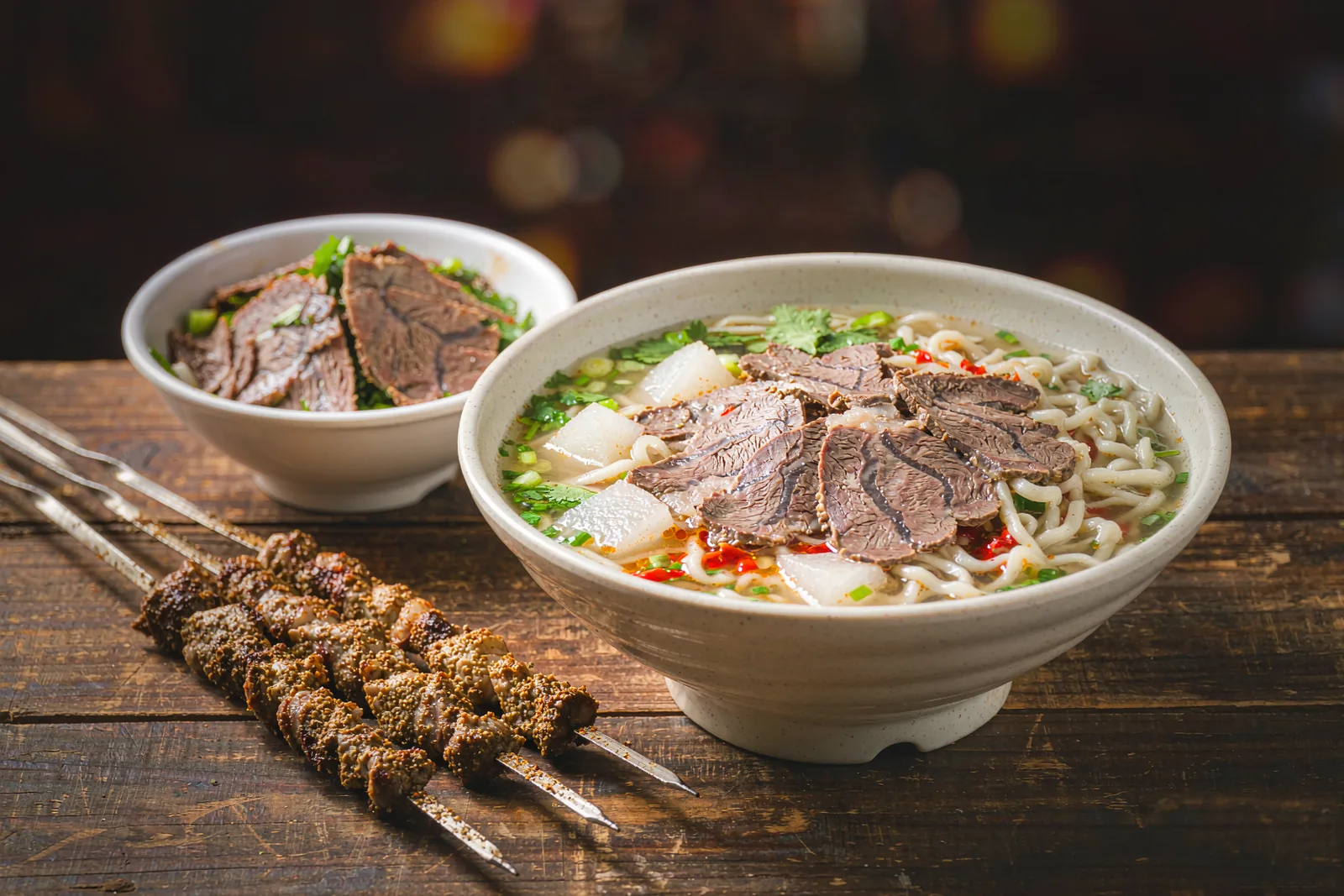
Lanzhou lamian (兰州拉面) is the region's most famous export, a bowl of hand-pulled wheat noodles in clear beef broth, topped with sliced beef, radish, chilli oil and coriander. The noodles are pulled to order in seven widths — from hair-thin maoxi (毛细) to wide kuan (宽). The classic call is yi qing er bai san hong si lv: clear broth, white radish, red chilli, green herbs. Eat it for breakfast, the way Lanzhou does.
Xi'an: the capital of street food
- Roujiamo (肉夹馍) — slow-braised pork or beef chopped and stuffed into a crisp flatbread; often called "the Chinese burger".
- Yangrou paomo (羊肉泡馍) — torn flatbread simmered in mutton broth, the city's defining bowl.
- Biangbiang mian (油泼面) — wide, belt-like noodles under a sizzle of hot chilli oil.
- Liangpi (凉皮) — cold wheat noodles in vinegar and chilli, a summer staple.
Most of Xi'an's classics cluster in the Muslim Quarter, which is worth an evening of grazing. See our street food guide for the mindset, even if the cities differ.
Lamb, cumin and the grill
The far west cooks over open flame. Yangrou chuan (羊肉串) — lamb skewers rubbed with cumin, chilli and salt over charcoal — are the great equaliser, sold from every night-market stall from Xi'an to Kashgar. Kao quan yang (烤全羊), a whole lamb roasted on a spit, is the banquet centrepiece. Dapanji (大盘鸡), "big plate chicken", is a heaping platter of chicken, potato and wide noodles stewed with dried chillies — born in Xinjiang, loved everywhere.
Bread, dairy and Central Asia
The region's Central Asian heritage shows in nang (馕) the stamped oven bread, laghman (拉条子) pulled noodles with a meaty sauce, samsa (烤包子) baked lamb pies, and yogurt (酸奶) and nang cha (奶茶) milk tea served with every meal. Hand-pulled rice zhua fan (手抓饭) — pilaf with lamb, carrot and raisins — is the celebratory dish, cooked in a vast wok and eaten, traditionally, with the right hand.
Where to eat it
Xi'an for the street-food density, Lanzhou for the noodle houses, and Kashgar, Turpan or Urumqi for the Central Asian side of the table. Our Xi'an, Kashgar and Urumqi pages pair the food with the Silk Road sights, and a local guide can order the right noodle width and navigate the night markets.
FAQ
Is Northwest Chinese food spicy?
Mostly not. Cumin, chilli flakes and vinegar season the food, but the heat is mild compared with Sichuan or Hunan. The lamb and bread carry the flavour.
I don't eat lamb — what are my options?
Plenty. Roujiamo comes in beef and pork, dapanji is chicken, and the noodle houses offer beef. In Hui Muslim areas lamb is the default, but beef is usually available.
What does "yi qing er bai" mean?
It is the standard for Lanzhou beef noodles: clear broth, white radish, red chilli oil, green coriander. Say it and you sound like a regular.
Is the food suitable for vegetarians?
Limited but workable — liangpi cold noodles, nang bread, yogurt and vegetable noodles exist. For the full picture see our vegetarian guide.
Related reading
For the other great noodle-and-broth traditions, see our breakfast guide; for drinking with the meal, baijiu culture.
Related guides