Northeast China Cuisine (Dongbei): Hearty Stews, Guo Bao Rou and More
Northeast China — the three provinces of Liaoning, Jilin and Heilongjiang — cooks for a climate that hits minus thirty. The result, Dongbei cuisine (东北菜), is China's most generous table: enormous portions, sour-pickled cabbage, pork-and-potato stews, and one sweet-sour pork dish that every visitor remembers by name. If Sichuan food is a fire, Dongbei food is a bear hug.
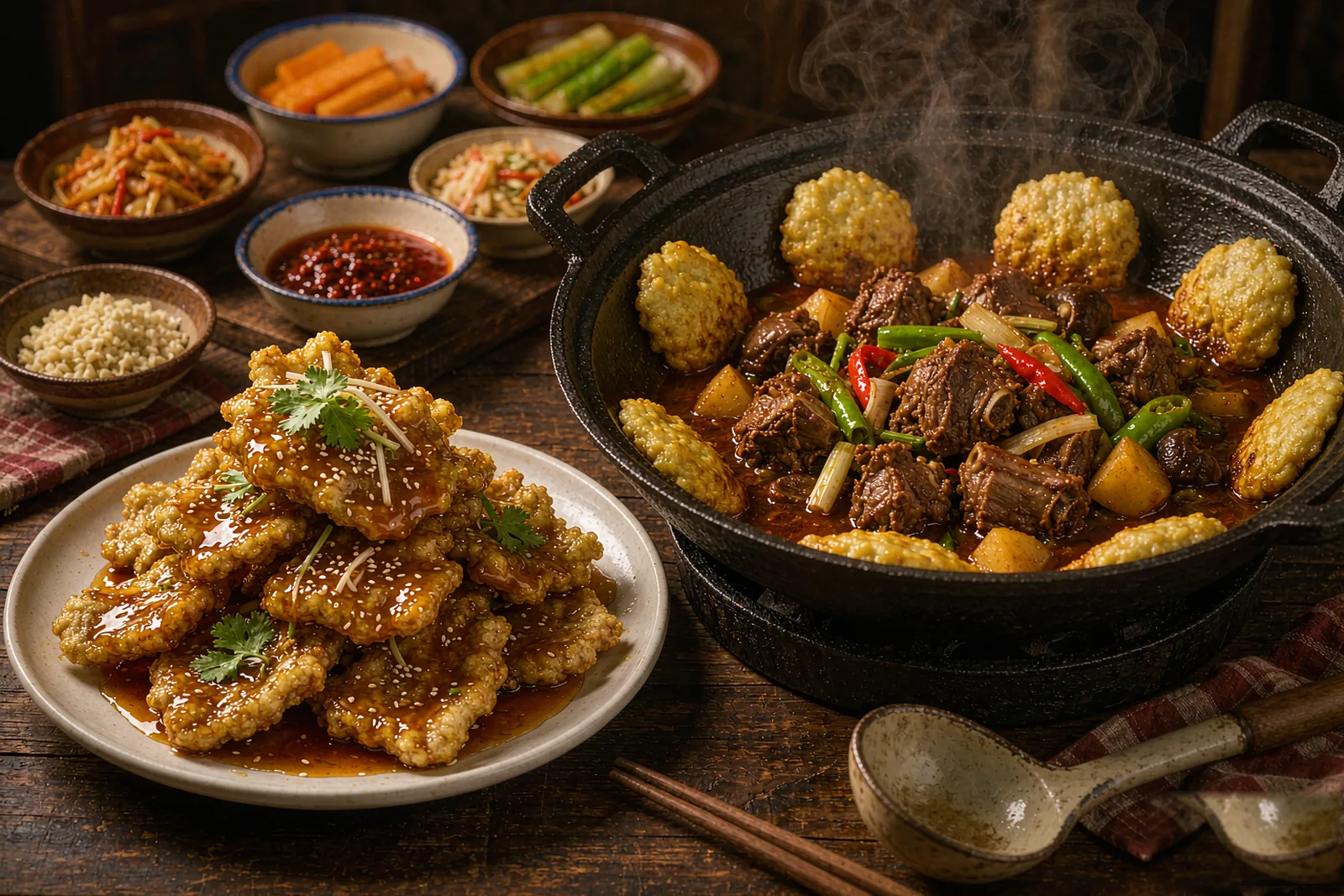
Why Dongbei food is built the way it is
Long, brutal winters shaped everything. Vegetables were salted and fermented to survive the freeze — hence suancai (酸菜), the region's signature pickled napa cabbage. Pork was the main protein because pigs wintered indoors. And portions grew huge, because a body working in the cold needs fuel. Expect bowls, not plates; sharing, not à la carte; and a host who insists you eat more. See our beginner's guide for table manners before you sit down.
The dish everyone asks about: guo bao rou
Guo bao rou (锅包肉) is the Dongbei classic: thin pork cutlets in a crisp starch coating, tossed in a sweet-and-sour sauce that leans more sweet than sour. It was invented in Harbin around 1900 by a chef catering to Russian palates — which is why it reads like sweet-and-sour pork's northern cousin. The good versions are light and shattering-crisp; the sauce should coat, not soak.
The stews and the iron pot
- Suancai bairou (酸菜白肉) — sour cabbage simmered with fatty pork and often blood sausage, the taste of a Dongbei winter.
- Xiaoji dun mogu (小鸡炖蘑菇) — chicken stewed with wild mushrooms and glass noodles.
- Tieguo dun (铁锅炖) — a communal iron pot of fish, chicken or ribs stewed with corn cakes slapped around the rim. Order it for a crowd and expect to be there a while.
Cold dishes, dumplings and the rest
Dongbei cold appetisers are a thing of their own: dongbei liangcai (东北凉菜), paid huanggua (拍黄瓜) smashed cucumber, and lashou cai (拉皮) cold starch-sheet salad in sesame and vinegar. Dumplings are the region's other love — Harbin in particular makes some of China's best jiaozi, and there is an argument that Dongbei is the true dumpling heartland. Our dumpling guide settles the geography.
Russian and Korean echoes
Harbin was built by Russian railway engineers, and the influence lingers: hongchang (红肠) smoked red sausage, lieba (列巴) the dense Russian bread, and a local taste for beer and cream. The Korean-Chinese communities in Jilin and Liaoning add lengmian (冷面) cold noodles and kaolengmian (烤冷面) the grilled street version. It makes Dongbei food more varied than its meat-and-cabbage reputation suggests.
Where to eat it
Harbin for the Russian-tinged classics and the ice festival, Changchun and Shenyang for honest neighbourhood stews, Dalian for the seafood twist on the coast. Our Harbin and Changbaishan pages pair the food with the region's winter landscapes, and a local guide will order a proper iron-pot stew and negotiate the portion sizes.
FAQ
How big are the portions really?
Very. A single stew can feed three or four. Order one main dish per two people, add a cold appetiser, and stop. Hosts will still tell you to eat more — it is affection, not a command.
Is Dongbei food spicy?
Not by Chinese standards. The heat comes from garlic, vinegar and the odd chilli, never a proper burn. It is rich and sour rather than hot.
What is suancai?
Napa cabbage lacto-fermented with salt — Dongbei's version of sauerkraut. It gives suancai bairou its sharp, comforting sourness and is a winter staple across the region.
Can I get a vegetarian version of the stews?
The broth is usually meat-based, but many places do potato-and-cabbage and mushroom pots. See our vegetarian guide for how to navigate it.
Related reading
For the dumpling culture that runs through Dongbei, see our dumpling guide; for the opposite, fiery end of China, Hunan cuisine.
Related guides