Cancer Treatment in China: 4 International Patient Stories (2026)
Statistics hide what stories reveal. Four international patients — a Pakistani engineer, an Iranian teacher, a Tanzanian businessman and a Malaysian woman — show what cancer treatment in China actually looks like, from first contact to follow-up.
Story 1: The headache that wasn't a headache (Karim, 38, Pakistan)
Karim, a telecom engineer from Islamabad, spent two years treating worsening left-sided headaches as "migraine" — a private clinic's non-contrast CT had reported no mass. When his right eye's vision began fading and his left face went numb, a colleague pointed him to Beijing.
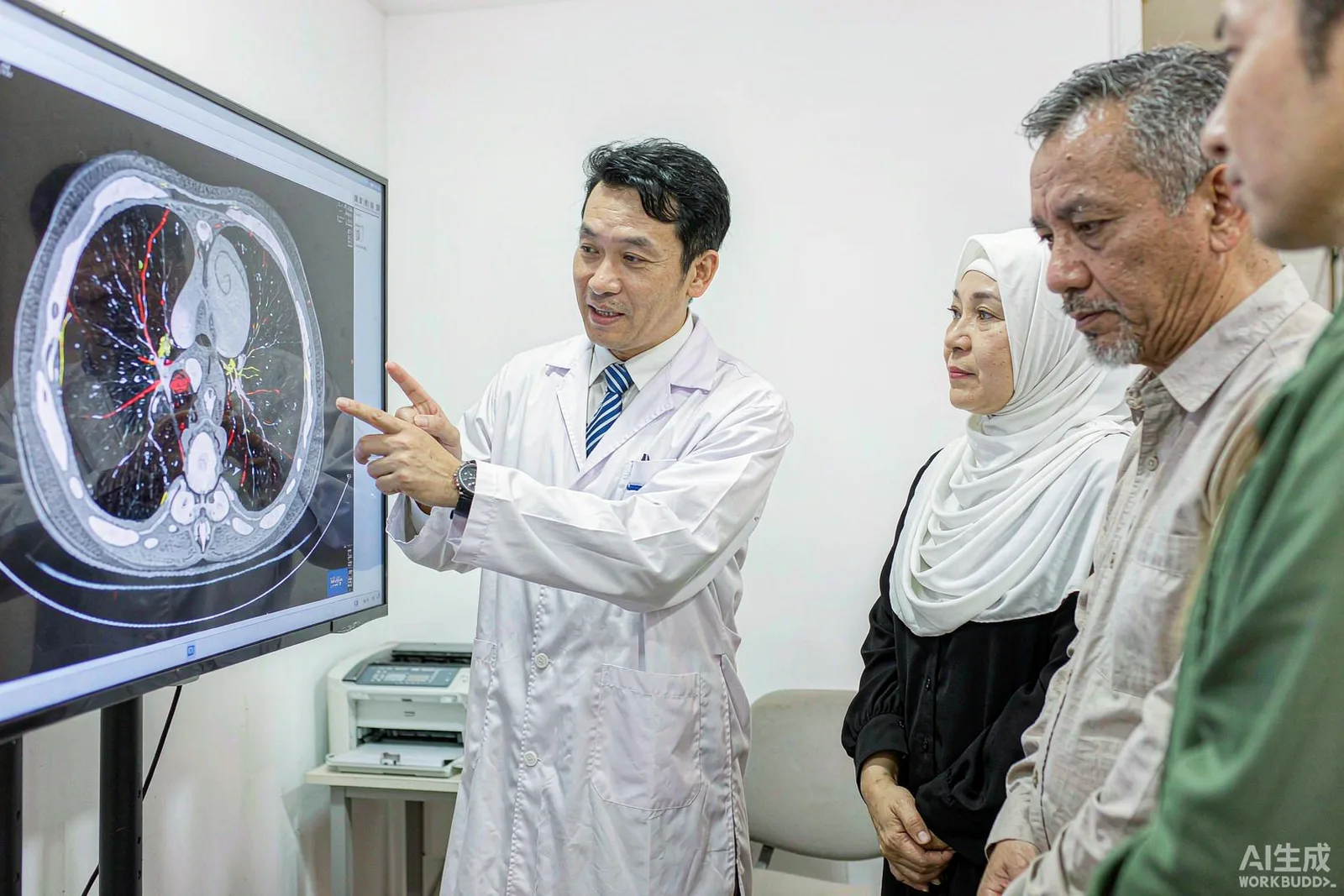
At the Cancer Hospital of the Chinese Academy of Medical Sciences, a 3T MRI with CTA told a different story: a 3.2 cm meningioma at the left sphenoid wing, compressing the optic nerve and wrapping the internal carotid artery. Neurosurgeon Wan Jinghai's team planned a pterional craniotomy with neuronavigation and intraoperative monitoring. The operation took four hours with 300 ml of blood loss and achieved a Simpson grade I total resection — the most complete removal grade. Pathology confirmed a benign WHO grade I tumor with clear margins; Karim flew home to Islamabad six weeks later, vision recovered, back at full-time work.
What the story shows: Chinese neurosurgery's differentiation is standardized precision — navigation, monitoring, and pathology verification are routine, not premium add-ons. And the diagnostic gap matters more than the surgery gap: a contrast MRI years earlier would have caught a curable tumor.
Story 2: From "no drugs available" to first-line immunotherapy (Tima, 48, Iran)
Tima, a teacher from Tehran, had acral melanoma — the subtype that dominates in Asian populations, arising on soles and palms — with lymph-node and lung metastases. Iran's imported PD-1 drugs were expensive and chronically short; chemotherapy offered under 10% response odds.
At China-Japan Friendship Hospital in Beijing, Dr. Jia Liqun's team ran NGS sequencing that ruled out targeted therapy (BRAF/NRAS/c-KIT wild-type) and prescribed toripalimab — a Chinese-developed PD-1 antibody approved for first-line melanoma in 2025 and added to China's national insurance list in January 2026, collapsing its price. After two cycles (six weeks), her PET-CT showed the largest lesion shrinking from 2.8 cm to 1.7 cm — nearly 40% — with tumor markers normalizing. She continues maintenance dosing every three weeks.
What the story shows: China's acral and mucosal melanoma expertise exceeds Western centers' — these subtypes make up over 70% of Chinese cases versus under 5% in the West, so Chinese protocols are built around exactly her disease. Domestic immunotherapies, sustained by the world's largest generic-plus-innovation pharmaceutical base, make ongoing treatment financially sustainable.
Story 3: Remote work-up, one-week cure (Mwaka, 54, Tanzania)
Mwaka, a businessman from Dar es Salaam, had mid-stage liver cancer that local hospitals could only palliate. Rather than flying blind, his care started at home: through a China–Tanzania AI telemedicine platform, his CT scans were transmitted and reviewed remotely by Shandong Cancer Hospital physicians, who confirmed he was a candidate for image-guided cryoablation.
The procedure itself took 15 minutes of super-cooled argon freezing to destroy the tumor completely. He walked independently two days later, went home in a week, and three months on, his tumor markers were normal and he was back at work — with a Swahili interpreter having accompanied him throughout.
What the story shows: The pipeline matters as much as the procedure. Remote pre-evaluation means patients fly only when treatment is actually confirmed feasible; cryoablation's quick recovery fits a short trip; and China's medical-diplomacy network (the same hospitals that staff medical missions to Africa) creates trusted referral channels.
Story 4: Beating chemo-resistant ovarian cancer (Chen, 47, Malaysia)
Chen's recurrent serous ovarian cancer had resisted six months of first-line chemotherapy in Kuala Lumpur, and Singapore's imported targeted drugs were beyond her budget. Malaysia's 30-day medical visa-free arrangement made Shanghai practical — coordination took under 48 hours.
At Fudan University Shanghai Cancer Center, genomic testing identified a druggable mutation, and her team combined a domestically manufactured targeted agent with HIPEC — hyperthermic intraperitoneal chemotherapy, a heated wash that reaches peritoneal seedlings systemic drugs miss. After two cycles, her tumor markers fell 72% and the ascites causing her abdominal distension disappeared entirely.
What the story shows: Gynecologic oncology depth plus domestic drug pricing creates options that Western-list-price targeted therapy prices out. The visa-free lane for Southeast Asian patients removes the last logistical excuse.
The pattern across the four stories
- Diagnostics first. Every case began with re-imaging or re-sequencing that changed the plan — bring your raw data (DICOM images, pathology blocks), not just summaries.
- Speed is clinical. Compressed timelines (days from admission to treatment) reduce both cost and tumor progression anxiety.
- Follow-up is designed in. Video reviews, remote device programming and bilingual discharge summaries keep the relationship alive after the flight home.
- Costs stay transparent. Itemized pre-estimates are standard; final bills in these story types typically run a third to half of Western equivalents.
If your case involves blood cancers or gastroesophageal tumors, read our CAR-T guide next; for cardiac and pediatric surgical stories, see our cardiac care guide.
Related guides