
Guest — sign in to save your enquiries.
My account
At 3,079 metres, the Golden Summit of Mount Emei is the crowning moment of Sichuan's most sacred mountain — a place where a 48-metre bronze Samantabhadra statue rises above a sea of clouds. Pilgrims come for the sunrise, the Buddha's halo and the sheer altitude; our private guides handle the shuttles, cable cars and timing so you simply watch the light break over the Tibetan plateau.
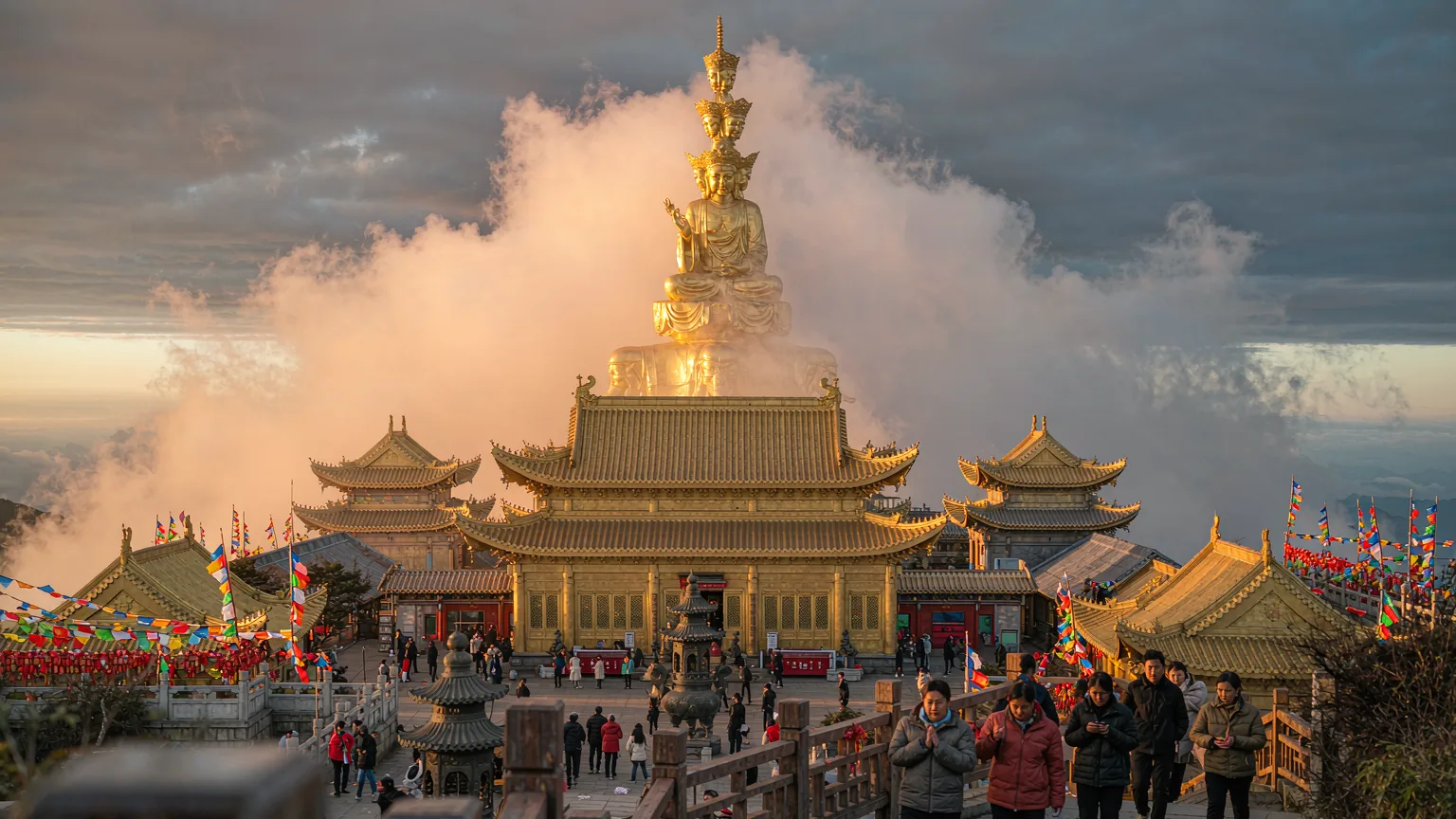
Mount Emei is one of China's four sacred Buddhist mountains and a UNESCO World Cultural and Natural Heritage Site, revered as the earthly home of Samantabhadra, the Bodhisattva of Practice. The Golden Summit, or Jinding, has drawn pilgrims for more than a thousand years; the first temple was built here in the Eastern Han dynasty, and emperors of the Ming and Qing dynasties sent tributes. The current bronze statue, completed in 2006, stands 48 metres tall and weighs over 600 tonnes, facing the sunrise. Below it, the Huazang Temple and the 1980s-era Golden Hall and Silver Hall form a compact sacred complex that feels suspended above the world.
The summit sits at 3,079 metres, nearly 2,000 metres above the town of Emei. The climate is alpine and famously changeable: clear skies can turn to fog within minutes, and snow lingers from November to April. The classic rewards are the sunrise, the cloud sea that fills the valleys below, and the rare 'Buddha's halo' — a rainbow ring around your own shadow, produced by sunlight refracting through mist. Because the summit is reached by a combination of bus and cable car, most visitors can experience it in a single day, though staying overnight at a summit hotel gives the best chance of catching dawn.
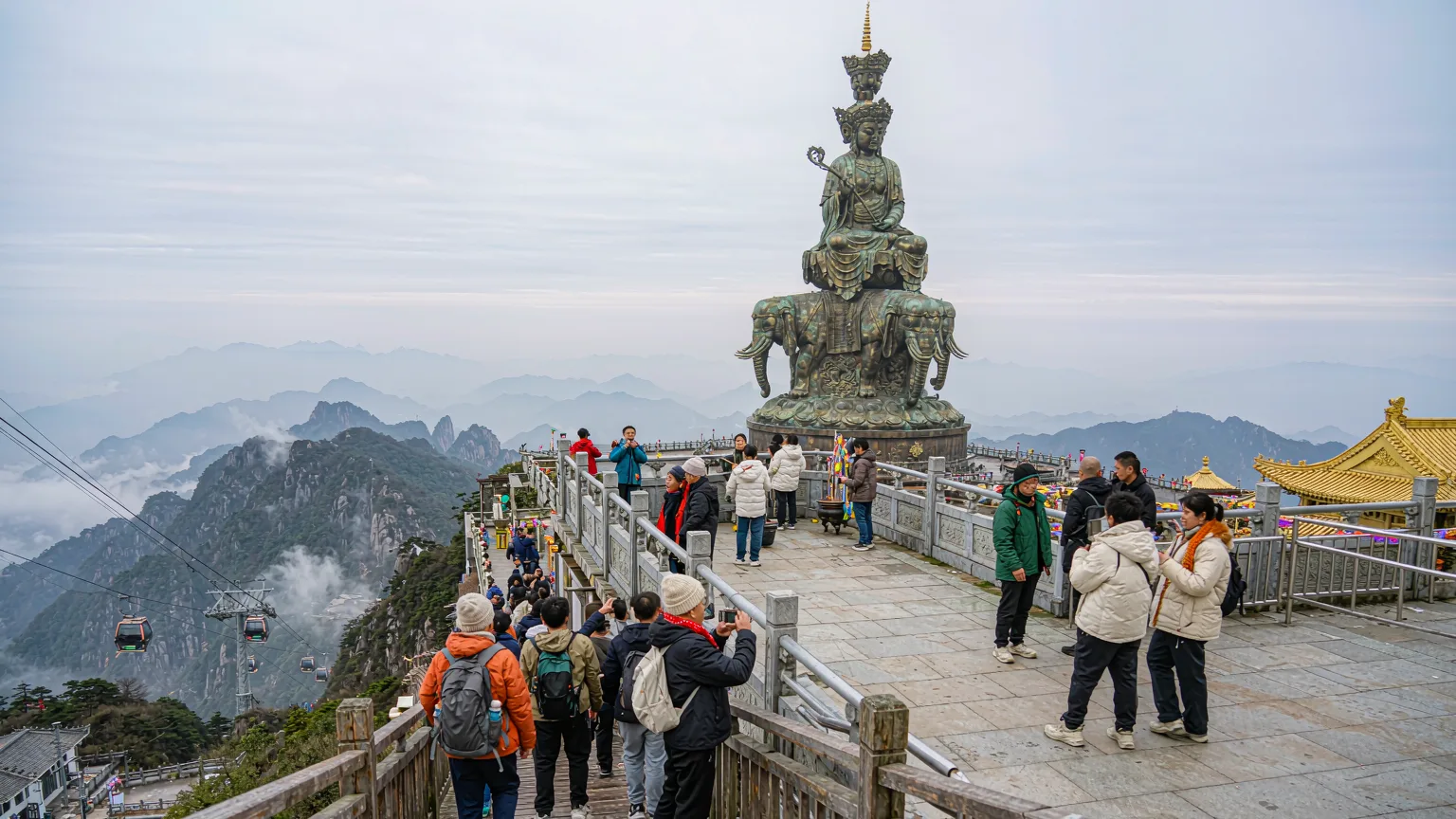
From Chengdu, take a high-speed train from Chengdu East or South Station to Emeishan Station (about 1.5 hours, ¥65–¥90). From the station, a taxi or local bus (¥10–¥20) reaches the Baoguo Temple area, where you catch the official mountain shuttle bus to Leidongping (2 hours, ¥90 return). From Leidongping, walk 20 minutes to the cable car station and ride up (¥65 up, ¥55 down). Our private guides arrange tickets and transfers so you avoid queues and timing stress.
Mount Emei entrance ticket: ¥160 (valid 2 days). Shuttle bus to Leidongping: ¥90 return. Cable car: ¥65 up, ¥55 down. Summit attractions are included in the entrance ticket. Opening hours: 6:00–18:30 (shuttle buses), cable car 7:00–18:00; hours vary seasonally.
Book tickets in advance via the official WeChat mini-program 'Emei Mountain Tourism' or Trip.com. Foreign credit cards are accepted on Trip.com; for WeChat Pay and Alipay, link an international card or ask your guide to help with cash top-ups at the ticket office.
The best time to visit is September to November for clear skies and comfortable temperatures, or April to June for wildflowers and fewer crowds. For sunrise, arrive at the summit by 5:30am in summer or 6:30am in winter; the cloud sea is most reliable after rain. Avoid Chinese public holidays, when queues for the cable car can exceed two hours.
Yes, but it is a long day: leave Chengdu by 7am, take the high-speed train, shuttle and cable car, and you will be back by 8–9pm. Staying overnight in Emei town or at the summit is more relaxed.
No. You can hike from Leidongping to the summit in about 1.5–2 hours, but the altitude makes it strenuous. Most visitors take the cable car up and walk down, or vice versa.
Fog is common and can clear suddenly. Wait 30–60 minutes in the Golden Hall or teahouse; if it persists, enjoy the temple interiors and try again on your descent. Our guides monitor conditions and adjust timing.
No ATMs. Small vendors accept WeChat Pay and Alipay, but bring ¥200–¥300 in cash for snacks, incense or coat rental. Credit cards are not accepted on the mountain.
Tell us your dates, group size and preferences — a dedicated consultant will reach out within 24 hours.